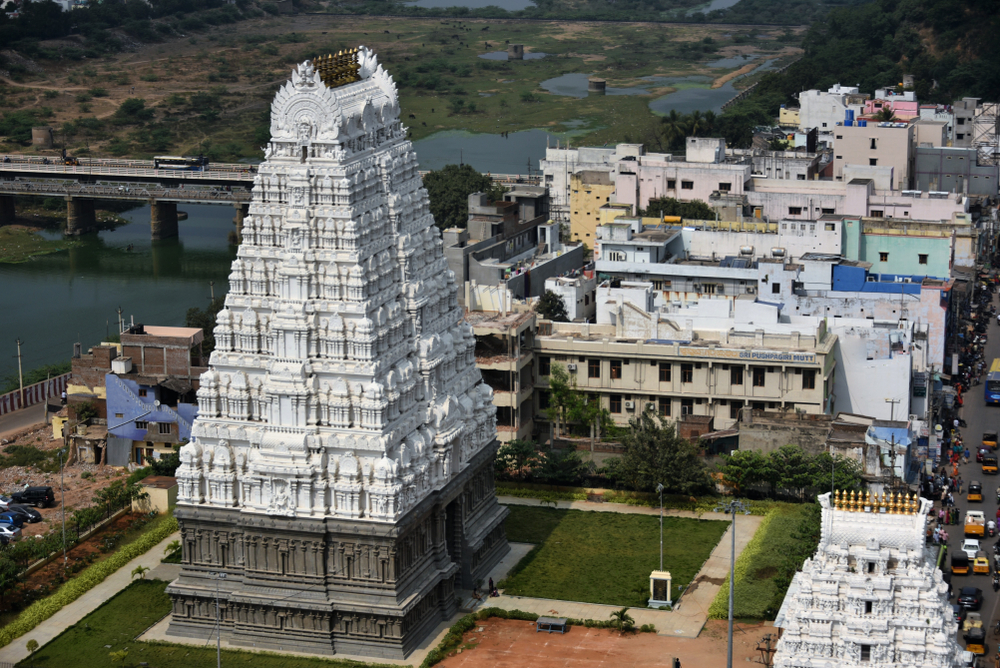
Sri Kalahasteeswara temple – The Kashi of South
Sri Kalahasteeswara Temple (also known as Srikalahasti Temple) is one of South India’s most well-known Shiva temples. Kannappa, a famous Shiva devotee, was about to donate both of his eyeballs to cover the blood gushing from the Siva linga when Lord Siva stopped him and granted mukti. The temple is also regarded as Rahu-Ketu kshetra and Dakshina Kailasam.
The three ancient epics, the Skanda Purana, Shiva Purana, and Linga Purana, all mention the ancient Shiva temple of Sri Kalahasti. Arjuna came to this location to worship Kalahastheeswara (Lord Shiva) and met Rishi Bharadwaja on the crest of a hill, according to the Skanda Purana.
The main gate of this temple is guarded by a 120-foot-high huge and old gopura. The temple is carved entirely out of the side of a massive stone hill. The Pallava dynasty built the original construction of this temple in the 5th century. In the 10th century, Chola monarchs rebuilt the temple and built the main building. The outer walls and four gopuras were constructed during the reign of Vijayanagara King Sri Veera Narasimharaya. Krishna Devaraya, the renowned Vijayanagara ruler, built the main gopura and the 100-pillared mandapa in 1516. The Srikalahasti Temple’s main entrance is to the south, while the major shrine is to the west. Inside the temple, the Shiva Lingam is made of white stone and is shaped like an elephant’s trunk. The Sadyogi Mandap and the Jalkoti Mandap are two more mandaps in the temple complex. It also has two water bodies – Chandra Pushkarani and Surya Pushkarani.